
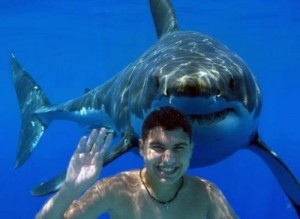
 Photo by egarc2. Licensed by Creative Commons.
“Swim with sharks and stingrays!” challenged the chalkboard signs all over Caye Caulker, a tiny mangrove island off the coast of Belize.
There were several good and sensible reasons why I should not do this. One: I swim like a dog. Sharks can probably walk faster than I swim. Two: I had snorkeled once in my life, for a quarter of an hour. My mouth kept filling with salt water and whenever I tried to stand up and clear my snorkel I fell over my flippers.
On the last day, though, my cowardice shamed me. I took a long shower (I don’t know much about sharks, but I was fairly sure they wouldn’t like the taste of soap), walked over to Anwar Tours and signed up.
Our guide was Carlos, a young man in his twenties from a group of islands farther out into the Atlantic where the sharks are presumably bigger. I glanced surreptitiously at the other passengers to see if they looked meatier and more appetizing than me. Two sturdy young Dutch women, both with a certain amount of meat on their bones, neither with any snorkling experience, seemed the obvious entrees. Four of the other passengers sucked nervously on cigarettes. Good, thought I, a non-smoker. Might give me an edge in the desperate sprint back to the boat.
We made for Shark-Ray Alley, a shallow, sandy area perhaps sixty yards inside the reef. Four boats were already there, and the space between them was crowded with snorklers, standing, ducking, swimming, standing again, pointing. It was like a pool party. I expected them to surface and clink martini glasses. Small dark shapes passed under our boat like flying carpet squares: the rays.
Carlos cut the engine and told us what we hadn’t been told before about the sharks and the stingrays: they were almost completely harmless. “They’re bottom-feeders. They only eat things that crawl or have crawled.” Lobster. Conch. The nurse shark don’t even have teeth, just very rough, sandpaper-like drains. Their jaws are strong enough to crush a conch, but the fact is, they just don’t attack people. “They’ll bite you if you put your hand in their mouth,” Carlos said, “but I’d bite you if you put your hand in my mouth.”
As for the rays, he said, we were far more likely to hurt them than they were to hurt us. A stingray will only sting if stepped on, whereas if we merely touched the ray’s upper surface we’d take off some of its protective slime, effectively excoriating it and promoting infection. If we saw white spots on a ray, he said, that’s where the skin had been handled, and was beginning to break down.
He had barely finished talking when our group started leaping overboard. I stepped carefully into the water to avoid stepping on a ray, pulled on my mask, ducked my head underwater, and at once saw a dozen pairs of yellow, blue and black flippers breaking through the quicksilver surface, kicking clumsily, churning up sand and bubbles. Beneath them, the dark-brown nurse shark, with its small white eyes, seemed blind; it snuffled across the sand apparently unaware of us. A hand grabbed at its tail; it shrugged effortlessly out of reach. Almost all the rays, especially the bigger ones, had white patches or streaks across their wings. Each time one undulated effortlessly under me, I drew up my knees and sucked up my stomach, not because I was afraid of its sting but because the ray belonged there and I didn’t.
As one of my ears broke the surface among the partiers I heard a male voice ask, “So, what did you guys wind up doing last night?”
Back in the boat, we were an oddly silent bunch. Carlos told us the history of the domestication of the sharks and rays, how a single tour guide had started feeding them, which made the sharks and rays dependent on human hand-outs and predictable in their movements. By now both species were cowed and docile, he said, and every guide and boat operator on the island cashed in, even him. But it could be worse: at the Shark-Ray Alley off Ambergris Caye, the bigger and more commercial island north of Caye Caulker, the guide will pick the shark out of the ocean, he said, and put it into the boat so everyone can photograph it.
The sun was low. It was time to head back to Caye Caulker, but when Carlos went to start to engines, he had to wait. Behind the boat, too close to the propellors for safety, swam five nurse sharks like stray dogs, hoping to be fed.
This essay was first broadcast in February 2001, I think.
Related Articles
1 user responded in this post
[…] Swim with Sharks! […]
Leave A Reply